

Peatland restoration in Bannau Brycheiniog is more than bog standard
Adfer mawndir ym Mannau Brycheiniog
A major peatland restoration project in the Black Mountains is saving tens of thousands of tonnes of carbon emissions every year – the equivalent of taking 169 cars off the road – thanks to £1.2m of Welsh Government support.
The initiative, which has been delivered by the National Park Authority in partnership with local graziers and contractors has significantly exceeded its original targets –to help absorb carbon and protect unique wildlife habitats.
Eroding peatland is a significant contributor to carbon emissions, with peatlands storing over a quarter of Wales' land-based carbon despite covering only 4% of the land.
The project in Bannau Brycheiniog has achieved remarkable results, seeing 38km of peat hags; the eroded gullies and overhangs of peat, stabilised against an original target of just 10km.
10km of bare peat surface has also been planted with mosses and grasses, resulting in over 89 hectares of exposed peat being protected against an initial target of 3 hectares – saving thousands of tonnes of carbon emissions each year.
The restoration work has installed 530 leaky dams and 700m of biodegradable coir bunding to manage water runoff and re-wet the peatland and seen over 6km of pathways restored to prevent erosion from walkers.
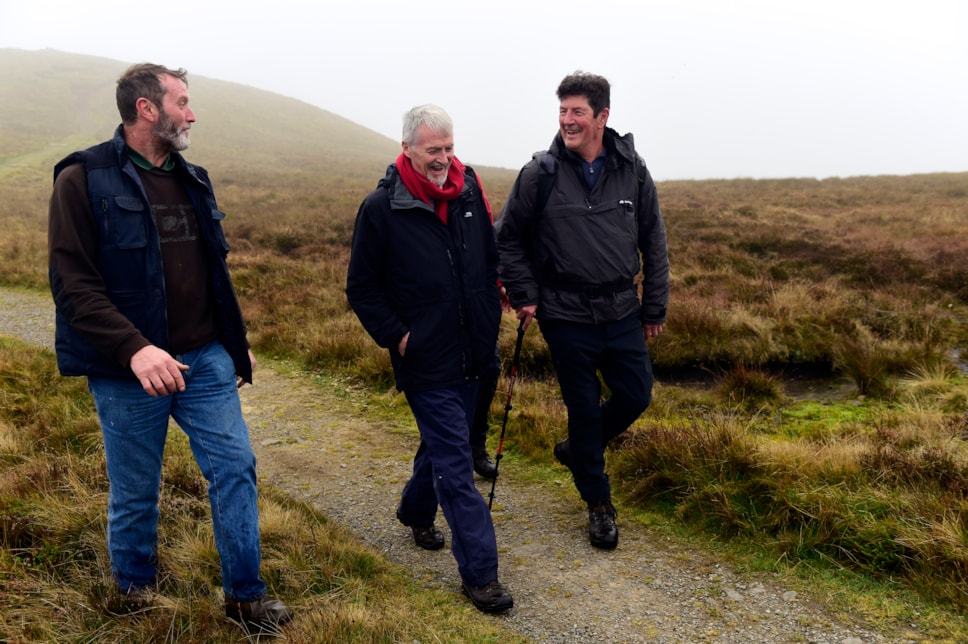
On a visit to see the results of the project for himself, the Deputy First Minister with responsibility for Climate Change, Huw Irranca-Davies, said:
"Peatlands are fantastic at absorbing carbon and also providing unique wildlife habitats, but they often need our help to restore them to good condition.
“Diolch o galon to the whole team behind this effort to improve our valuable peatlands. It shows how ambitious, landscape-scale projects can deliver real change for Wales.”
Last year, the Welsh Government beat its initial 5-year target of restoring 3,000 hectares of peatland 12 months early.
An additional £5.2m has since been pledged to build on the progress achieved by the National Peatlands Action Programme (NPAP), which is delivered by Natural Resources Wales.
The funding for the work in Bannau Brycheiniog is in addition to the NPAP funding and has been provided from the Welsh Government’s Sustainable Landscapes, Sustainable Places programme, which provides capital investment to National Parks and National Landscapes to deliver projects supporting nature, climate change mitigation, sustainable tourism and resilient communities.
Landmark legislation has also been introduced which will strengthen support for different groups throughout Wales to come together and work to protect nature.
The Environment (Principles, Governance and Biodiversity Targets) (Wales) Bill will play a crucial role in safeguarding Wales' natural environment.
The Deputy First Minister added:
“We will continue close collaboration with our partners to address the climate and nature emergencies while supporting exciting green job opportunities across Wales to support our economy.
“Only by working together can we make a significant change.”
Notes to editors
The Welsh Government provided more than £14m since 2022 through the Sustainable Landscapes, Sustainable Places (SLSP) capital fund for our National Parks and National Landscapes (collectively known as the Designated Landscapes).
The funding is designed to support key national priorities through four thematic areas: promoting biodiversity and nature recovery, accelerating decarbonisation, supporting resilient communities, and delivering sustainable tourism.
The funding is provided to National Park Authorities and Local Authorities who develop project proposals tailored for their own habitats and communities.
Over 216,000 trees have been planted and 967 hectares of land better managed for biodiversity.
A series of videos have been commissioned by the Designated Landscape bodies to demonstrate achievements made through SLSP funding.
Information on currently supported projects can be found here.
The National Peatland Action Programme is a 5-year plan of peatland restoration in Wales. Welsh peatlands need urgent action to address the nature and climate emergencies.
Peatlands support a variety of habitats and species, they:
- capture and store carbon
- regulate greenhouse gases
- maintain biodiversity
- regulate water
Funded by Welsh Government, this programme was set up to coordinate peatland restoration action in Wales. Originally set a target of restoring 3,000 hectares by 2025, the Programme has gone 20% beyond that – reaching 3,600 hectares thanks to a fifth-year boost in delivery.
Crucially, these restored peatlands help lock in an estimated 1.92 million tonnes of stored carbon, helping to tackle the Climate and Nature emergencies.